
 Pricing
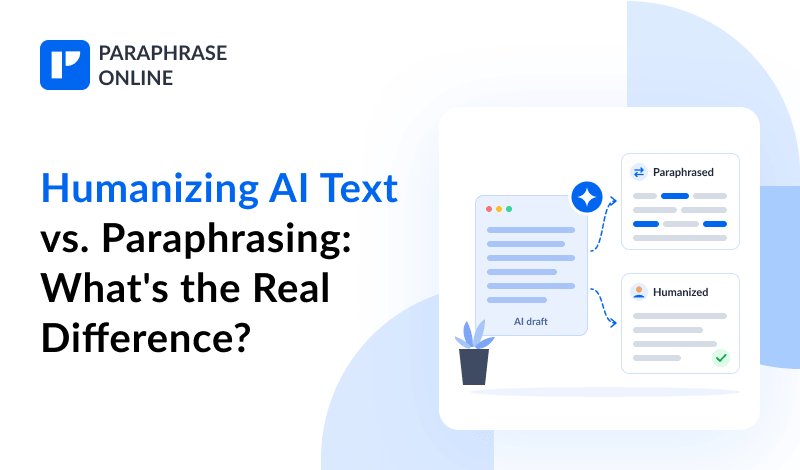


AI Writing Tools Can Quickly Create A First Draft; However, The Content Often Comes Across As Quite Robotic And Lacks Originality. Two Terms Often Brought Up When Trying To Improve AI Text Are Humanizing And Paraphrasing.
Although these two terms are similar, they are not the same. Paraphrasing is a technique used to reword an idea, whereas humanizing AI text is a wider editing process to make the content more understandable, natural, and relevant to the readers.
Knowing the difference between humanizing and paraphrasing can help you decide which method to use to improve your content.
What Is Paraphrasing?
Paraphrasing is the act of rewording content while maintaining the meaning. This could be used to simplify a complex sentence or make something more relevant to a different audience.
Example:
Original: “The application will notify you once the backup has been completed.”
Paraphrased: “Once the backup is completed, the app will notify you.”
Wording and sentence structure have changed, but the main point has been kept.
Paraphrasing is a specific technique and can be used on a sentence or paragraph. The main thing to consider is whether the meaning has been maintained.
What Does Humanizing AI Text Mean?
Humanizing AI text usually means editing an AI draft to make it more natural and relevant to a real audience. Whilst paraphrasing may be used, often more editing will be done. The editor may restructure the article, remove any repetition, check for accuracy, add extra context, and ensure the tone is correct. Also, they may change any vague statements into specific explanations.
A more helpful definition would be that humanizing is using editorial judgement to make an AI draft more useful, accurate, and suitable for the purpose.
The Difference Between The Two
An example of an AI-written sentence:
‘Businesses should use digital tools to improve productivity and achieve better outcomes.'
Paraphrased version:
‘Digital tools can help improve efficiency in companies and give better results.'
Whilst the wording has changed, the statement is still quite generic. As a business owner, you wouldn’t know what tools would be useful, what efficiency means, or what results you could expect.
However, if a human editor were to edit this, they may consider what the article is about. If it is about making appointments for a small clinic, they may reword the sentence to:
‘A shared booking system can save time for the receptionists when making appointments over the phone and allow patients to pick a time that suits them online.'
This has given a specific example and made the statement more specific. This may have taken information from elsewhere in the article or a verified source. Therefore, the editor must check that the information is accurate. This is not just rewording; it has improved the content.
Paraphrasing | Humanizing AI text |
Restates a specific idea | Reviews and revises a wider piece |
Focuses on wording and sentence structure | Can address tone, flow, evidence, detail, and audience |
Should preserve the source meaning | May require new reporting, context, or restructuring |
May not verify a claim | Includes fact-checking when done responsibly |
Why The Terms Get Mixed Up
Both techniques can be used to change the wording in a piece. Many editing tools will have options to 'rewrite,' 'humanize,' or 'paraphrase.'
Often, when writers are looking to improve their content, they will use paraphrasing. They may reword a repetitive paragraph, change the tone, and add some context. However, this is just one step in the wider editing process.
To easily determine which technique to use, consider why you want to do it. If it is to reword an existing point, then you are paraphrasing. If you want to make the whole draft more useful for the intended audience, then you are doing a wider editing process, often referred to as humanizing.
What Humanizing Should Involve
A good starting point when humanizing would be to understand why you are writing the article. Who is your audience? What are they trying to find out? What should they know by the end? This will help avoid the content becoming vague and just asking you to make it sound human.
Once you have this information, you can look at the draft and make a few simple changes.
- Ensure the main point is clear: Does the article answer the question in the title? Or is it going off topic?
- Avoid generic statements: Phrases like ‘in today’s fast-paced world’ often take up space but don’t tell the reader anything.
- Check the accuracy: Just because a sentence sounds confident doesn’t mean it is correct. Ensure any names, dates, numbers, quotes, or technical terms are correct by using reliable sources.
- Keep the flow well: Group similar ideas together and define terms before using them.
- Ensure the tone is right: A beginner’s guide, professional report, and personal essay shouldn’t sound the same.
- Only include useful information: Including a real example, clear explanation, or relevant limitations can help. However, adding a fake personal story can be misleading.
- Be specific in the ending: Ensure the conclusion gives the reader something useful to take away.
All of these require some judgement. Whilst editing tools can offer suggestions, you must decide whether they maintain the intended meaning and are suitable for your publication.
Does humanizing Make The Content Original?
No. Changing the sentence structure won’t make an article original. A paraphrased paragraph may still be too similar to the source. Originality is about the ideas, research, examples, analysis, and how it provides something useful.
If the draft has used any other articles, studies, interviews, or reports, you should keep track of these. Whilst the facts and ideas may have been paraphrased, you may still need to reference them. Editors should also check that there isn’t any repetition and that any examples or claims are supported.
The same applies to AI-generated text. Don’t assume that the content is accurate or completely different. You should still review, reference, and take responsibility as part of the publishing process.
What Humanizing Can’t Guarantee?
The term "humanizing" can make you think that there is a reliable way to make the text look like it was written by a human. However, there is no guarantee that changing the wording will show who wrote the content, that it will pass a detector, or that the information is accurate.
Trying to avoid detection can take your focus away from more important questions. Is the article accurate? Does it answer the reader’s question?
It should be considered whether the draft was created using AI, a template, notes, or a first draft. Ultimately, tweaking phrases cannot replace genuine human insight or rigorous fact-checking.
The Main Difference
Paraphrasing is a technique used to reword an idea while keeping the meaning. Humanizing AI text is a term used to describe a wider editing process.
This can be used in a variety of ways but is most useful when it means taking time to carefully edit the content for real readers. A strong content piece has a natural tone, is clear, includes relevant details, is accurate, and has a structure that respects the reader’s time. Whether AI helped create the first draft or not, those qualities come from the work of reviewing, checking, and making deliberate choices.